Wednesday, May 25, 2011

Refugees

Refugee Definition-     
 Refugees are poor people who have left their homelands because they fear that they will lose their lives or their freedom if they stay. People become refugees because one or more of their basic human rights has been violated or threatened

International law defines a "refugee" as a person who has fled from and/or cannot return to his/her country due to wee-founded fear or persecution, including war or civil conflict

A person is a refugee if
1.    Refugees have to be outside their country of origin
2.    The reason for their flight has to be fear of persecution
3.    The fear of persecution has to be well founded i.e. they have to have experienced persecution or will experience it when they return,
4.    The persecution has to result from one or more of the five grounds listed in the definition
5.    They have to be unwilling or unable to seek the protection of their country.


Who protects the refugees?
UNHCR
Protecting refugees is the core mandate of UNHCR (United Nations High Commissioner of Refugees


Why do they help?
This year, with the world economic crisis threatening to slash aid budgets and amid enormous global uncertainty, we need to ensure refugees are not forgotten. That's why the theme for this year's World Refugee Day on June 20 is "Real People, Real Needs."
Of the millions of people forcibly displaced by conflict, persecution and natural disasters, every one has a story to tell; they are real people, just like you and me, and they have real needs.

"Real People, Real Needs" - refugees are individuals with real needs, just like you and me.

Where are they involved?
africa, americas, asia and the pacific, europe middle east and north africa.

Identify the top 10 countries and continents of concern, record their population
1.       Asia
2.       Africa
3.       Pakistan
4.       Thailand
5.       Dem Republic Congo
6.       Iraq
7.       Somalia
8.       Sudan
9.       Syrian Arab Republic
10.   Iran

Monday, May 16, 2011

the philipines

The Philippines
is made u of more than 7000 tropical islands and has a population of 90 million. The country has a tropical marine climate with a dry season (now-April) and a wet season (may-Oct).
The capital city is manila metro manila is a sprawling cluster of 17 cities with municipalities such as Manila, Quezon, Makati, Pasay, and so on generating a populace to guess at perhaps start at ten million and keep counting
Manila has a high population density, with one district having over 68.000 people per square kilometre so at times it may feel a little crowded

Thursday, April 28, 2011

Human Rights

Article: 10
Everyone is entitled in full equality to a fair and public hearing by an independent and impartial tribunal, in the determination of his rights and obligations and of any criminal charge against him.
TRANSLATION - This means that everyone has freedom of speech to express their opinion and to determine their rights and obligations of any criminal crime charged against them. This means that they are allowed a fair trial and are innocent until proven guilty.

Article: 8
Everyone has the right to an effective remedy by the competent national tribunals for acts violating the fundamental rights granted him by the constitution or by law.
TRANSLATION - You have the right to get an answer from the courts of law if your fundamental human right s is questioned against.

Article: 3
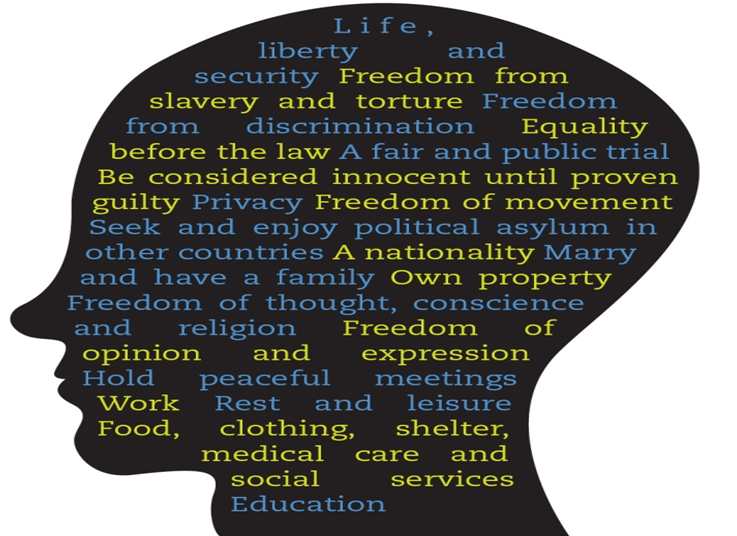
Everyone has the right to life, liberty and security of person
TRANSLATION - This means that everyone has a right to living a fair and just life. It means that everyone has the right to feel safe and to feel free. Free of control and restriction. This is a human right that is important in all cultures, religions and society. Everyone has a right to feel good and to express themselves.

Wednesday, April 27, 2011

United Nations

United Nations
The Declaration Of Human Rights
“Human rights are inscribed in the hearts of people”

What are human rights?
Human rights are the right and freedoms that we all have.
Some of the human rights are based in physical needs.
The right to life. To food. To shelter.
Other human rights protect us.
The right to be free from torture, cruel treatment and abuse
Human rights are also there to ensure we develop to our fullest potential
The right to education. To work. To participate in your community.
Everybody has human rights. It doesn’t matter who you are, where you come from, what language you speak or what religion you belong to. You have a duty to respect the rights of others, just as they have a duty to respect yours.
Nobody can take your rights away

Where do rights come from?
©       Dignity
©       Justice
©       Respect
©       Equality
Human rights were officially recognised as values by the world when the United Nations was set up

What is the United Nations?
The UN is an international organisation that was established in 1945, the year the Second World War ended.
Its founders hoped it would be able to prevent catastrophes like the Holocaust from happening in the future.
So promoting human rights became an aim of the UN, along with maintaining international peace and reducing poverty.

The Universal Declaration Of Human Rights
The United Nations universal Declaration of human rights (UDHR) is the most famous human rights agreement in the world. It contains 30 human rights.


Who Wrote the UDHR?

The people who wrote the UDHR came from: Australia, Chile, China, France, Lebanon, the former Soviet Union, the UK and the US


Monday, March 21, 2011

Kiribati

Note taking:  Kiribati & climate change
Issues:
*      Over population
*      Rising sea levels
*      More violent weather
*      Storms wash away part of the island
*      Lack of fresh water supply
Causes are:
*      Climate change
*      Pollution
*      Soil degradation
*      Erosion
*      Storm surges
*      And drought

Coral atoll containing 33 islands. 100 000 people live there.
The average height above sea level is less than 2m
They produced that their country will be under water by 2030!!!
It is hard for them to grow any food due to salivation. As when the water rises they receive salt in their crops!!!
The county will be uninhabitable long before it is sunk underwater.
All the water comes from underground. This means that all the waste for the land will seep into the underground water that they use and contaminate this.
The government is training his people to leave the country. Through education and training programs.
Other governments are providing education for this country. Australia has provided money for their country to receive some medical and nurse training.
Kiribati is a very Christian county.

Notes on: Tuberculosis Kiribati
300 people per 100000 people in Kiribati have tuberculosis. The world health organisation’s sees an issue if there is over 25 per 100000. Kiribati is well over this limit. The diseases are spread by coughing. This is a huge problem as Kiribati is overcrowded and disease spreads quickly. On average there are over 13people per household. There are 4 specials nurses who are dedicated to going out and identify people diagnosed with tuberculosis. They are funded by the Australian health organisation.
These nurses make sure these people receive help and isolate them while they receive help. So that they cannot give the disease to more people. Australian is also helping to build a lab and a pharmacy.  This is thought to decrease this problem by 30%.

note taking: Wheelcharis
Wheelchairs for students with special needs in kiribati, Australia volenteers international

Note taking:  Nurses of Kiribati
the kiribis austraian nurses enisiative, are allowing some students from Kiribati to undertake a nursing degree at the university in Brisbane. this project is founded by Oz aid. the nursing program is in response to climte change. it is so that they can help their community nd if the need occurs they can migrate with some skills at hand. so that they are useful to the country they migrate too. the nurses recieve 4 months of training in Kiribati and then more training in Brisbain at the university of Grithif. the Kiribati people are training their citizens as Nurses as their are not enough nurses all over the world.


Friday, March 18, 2011

India
1.    What are the recent achievements and challenges of our country?
India has some frequent natural disasters, with such a large population; this means that lots of Indian’s are affected. Although India has a good system for responding to the disasters when they occur.  Cyclones occur in the bay of
Bengal, and they get damaging earthquakes in the central northern area.

 Deforestation, river and air pollution are major pressures on the environment.

2.   How does poverty affect people in our country?
Poverty affects people in india through disease . there is a high risk of people in india getting a disease. food or waterborne diseases in india are bacterial diarrhea, hepatitis A and E, and typhoid fever . Highly pathogenic H5N1 avian influenza has been identified in this country; it poses a negligible risk with extremely rare cases possible among US citizens who have close contact with birds (2009)
3.    How are people represented in the media in our country?
Poor people from India are represented in the media as people with unlucky circumstances as many are without adequate access to fresh water, food, shelter and medical procedures. This is shown to make people aware the poverty in the world. Indian people are also shown in the media to promote people donating to poverty organisations.
Poor people in India are not respected as well as the wealthy people in the media as they are seen as the lower class even through the poor people live in the same country as the expats and wealthy people so in the media often poor people are seen as second class citizens.


4.   How does the government support health and education?
The government has initiated various programs to improve health but India still suffers from health problems linked to poverty, malnutrition, rapid population growth, environmental pollution and neglect of children and women's well being. Life expectancy is about 70 years.
The average income is over three quarters of the population live on less than US $2 a day.
66% of Adults can read and write in India.
% of mobile phones is available to people in India.
The Government spends --- on Education in India per year

1.    What are the aid organisations doing to assist poor people in our country?
World Vision, Caritas, Red Cross, Oxfam and the Catholic Church

2.   How does trade assist our country
The United States of America and China are India’s biggest trading partners. Other major trading partners include United Arab Emirates, Singapore, Germany and Australia. Indian exports mainly are petroleum projects, textiles, gems and jewellery, engineering goods, chemicals and leather manufactures. Indian imports include crude oil, fertilisers, machinery, gems, fertilizer and chemicals. The major Australian export items to India are coal, gold, copper ore and fertilisers; Australia imports electric parts, pearls, gems and medicines from India as well.

3.    What is the average income (GPD per capital (PPP us$))?


4.   What percentages of people live below the national poverty line?
25% of Indies population are living below the poverty.
5.    What percentage of children attends primary school?
Primary education is compulsory in India, but only 66% of adults are literate and there is a big difference between males and females (male: 76.9% and female: 54.5%). This shows males are getting a better education than females.

6.    What percentage of adults can read (adult literacy rate)?


7.    What percentage of people has access to clean water (access to improved drinking water source)?
There are 128 million people living in India with no drinking water.

8.   12zWhat percentage of people has access to sanitation?
The there are 660 million people without access to sanitation in India which is 57%. So there are only 33% of people with access to sanitation.

9.    How old can children expect to live to (What is the life expectancy at birth)?


10.How many mobile (cellular) phones are available per 1000 people?
257.91 Per 1,000 people 
11.  How many internet users?
There are about 52 million uses but compared with the population of India which is 1,155,347,678, it is extremely low.


1.    What percentage of income is owned by the least wealthy 20% of households?


2.   How big is the gap between these the richest and poorest?
 The gap between rich and poor is massive. There is not equality and it is not a fair country. There are very rich places and people in India but there are extremely poor people in India as well. There are shanty towns as well as palaces which are not right and needs to be changed. The gap between rich and poor is huge.
Lowest 10% of money earned: 3.6% of the population-4159251641
Highest 10% of money earned: 31.1% of the population (2005)-3.593131279

3.    How much does the government spend on health?


4.   How much does the government spend on education?
India spends $980 000

Wednesday, March 2, 2011

poverty cycle

Poverty cycle
The cycle of poverty has been described as a phenomenon where poor families, become trapped in poverty for generations because they have no or limited access to critical recourses, such as:
·      Educational and
·      Financial services
Subsequent generations are also impoverish
There are multiple cycles of poverty – based on and among other things
·      Economic
·      Social
·      Spiritual and
·       geographical factors


many cycles overlap or perpuate new cycles and therefore any attempt to decipict the cycle of poverty will be far more simplistic than realistic
the figure below shows in very simple form how the cycle of poverty related to hunger keeps a person or household poor in one of the worlds developing countries


in september 2000 kofi annan former general secretary of the united nations. suggested that the world leaders could do something to end world povery. 189 counties agreed that by september 2015 they would acieve 8 goals in that direction. which are
  1. eradicate extreme hunger and poverty
  2. achieve universal primary education
  3. promote gender equality and empower women
  4. reduce child mortality
  5. improve maternal health
  6. combat diseases hiv/aids, malaria and others
  7. ensure enviromental sustainability
  8. develop a global partener ship for development