Thursday, May 26, 2011

Nobel Peace Prize

Outline what the Nobel peace prize is.

The Nobel Peace Prize is awarded to one person a year who is then recognised as a global hero. It is an honour to win and comes with a prize of money depending on how much the foundation has earned that year. (In 2009 the prize money was around $1.4million US dollars) Each winner or laureate also receives a gold medal (diploma).  The peace prize has been honouring men and women from all over the world since 1901. A person can only win the Nobel peace prize if they have done something outstanding; this can be in physics, chemistry, medicine, literature, and for work in peace and social justice. Alfred Nobel was a kind man who tried to make the world a better place. He was interested in social justice issues as well as promoting peace. It was him who formed the Nobel peace prize out of the money left in his will. The Nobel peace prize was one of five Nobel prizes bequeathed by Alfred Nobel.

What are the origins of the prize?

Alfred Nobel grew up in Sweden when Sweden was a very powerful Nation in northern Europe. Nobel was an amazing man. He was fluent in several languages, a scientist, an inventor, an entrepreneur, an author and he wrote poetry and drama. Nobel was also a pacifist; he was very interested in social and peace-related issues, and held views that were considered radical during his time.
The said interest shall be divided into five equal parts, which shall be apportioned as follows: /- - -/ one part to the person who shall have done the most or the best work for fraternity between nations, the abolition or reduction of standing armies and for the holding and promotion of peace congresses.”                                                          (Excerpt from the will of Alfred Nobel)
This piece of Nobel’s will, is what formed the Nobel Prize. This is the part of his will that states that he wants people recognised who either create alliances between nations, reduce armies and war or promote peace.

Brief background of the person.

Desmond Tutu was born in 1931 in Klerksdorp, Transvaal in South Africa. Desmond attended school at Johannesburg Bantu High School. After leaving school he trained first as a teacher at Pretoria Bantu Normal College. In 1954 he graduated from the University of South Africa. After three years teaching as a high school teacher he began to study theology. Desmond loved theolog and found himself climbing the rankings of the church and becoming a bishop. Desmond studied theology in England and he became a master of theology. In 1975 he was appointed Dean of St. Mary's Cathedral in Johannesburg, the first black to hold that position and one of Desmond’s major achievements! 1978 he became the first black General Secretary of the South African Council of Churches another great achievement. Desmond “Tutu formulated his objectives as “a democratic and just society without racial divisions” and has set forward the following points as minimum demands:

1.       Equal civil rights for all

2.      The abolition of South Africa's passport laws

3.      A common system of education

4.      The cessation of forced deportation from South Africa to the so-called "homelands" ”  


When and why Desmond Tutu was awarded the Nobel Prize?

Desmond tutu was awarded the Nobel Prize in 1984 for doing all within his power to ensure that:

·         There were equal civil rights for all in South Africa,

·         That South Africa's passport laws were abolished,

·         That everyone was entitled fairly to a common system of education,

·         The cessation of forced deportation from South Africa to the so-called "homelands"  

Desmond Tutu won the Nobel Peace Prize for his role as a unifying leader. Tutu is also recognized for playing a vital role in the campaign to resolve the problem of apartheid in South Africa. In addition Desmond Tutu is recognized for ensuring his people were not being discriminated against and were receiving equal rights in education and labour.

Explain why the person became involved in the work.

Desmond Tutu became an Anglican when his family changed religions. When tutu was 12 he moved to Johannesburg; that is where he met the Anglican priest Trevor Huddleston. Trevor Huddleston was a very influential character in Tutu’s life.  Desmond Tutu became involved in work with the church because Desmond had a fascination with theology and spirituality since he met Trevor Huddleston. Whilst Desmond was working as a high school teacher he rediscovered the beauty of the church. Shortly later, he left work at the high school he was working at and began working for the church. He became a priest and mastered theology whilst studying in London! Desmond also became a bishop. Trevor Huddleston was Tutus role model and Tutu followed in his footsteps. Trevor Huddleston opposed the system of legal racial separation (apartheid). Tutu also shared this strong dislike of apartheid and tried his hardest like Trevor to merge the races together as one.

Wednesday, May 25, 2011

Refugees

Refugee Definition-     
 Refugees are poor people who have left their homelands because they fear that they will lose their lives or their freedom if they stay. People become refugees because one or more of their basic human rights has been violated or threatened

International law defines a "refugee" as a person who has fled from and/or cannot return to his/her country due to wee-founded fear or persecution, including war or civil conflict

A person is a refugee if
1.    Refugees have to be outside their country of origin
2.    The reason for their flight has to be fear of persecution
3.    The fear of persecution has to be well founded i.e. they have to have experienced persecution or will experience it when they return,
4.    The persecution has to result from one or more of the five grounds listed in the definition
5.    They have to be unwilling or unable to seek the protection of their country.


Who protects the refugees?
UNHCR
Protecting refugees is the core mandate of UNHCR (United Nations High Commissioner of Refugees


Why do they help?
This year, with the world economic crisis threatening to slash aid budgets and amid enormous global uncertainty, we need to ensure refugees are not forgotten. That's why the theme for this year's World Refugee Day on June 20 is "Real People, Real Needs."
Of the millions of people forcibly displaced by conflict, persecution and natural disasters, every one has a story to tell; they are real people, just like you and me, and they have real needs.

"Real People, Real Needs" - refugees are individuals with real needs, just like you and me.

Where are they involved?
africa, americas, asia and the pacific, europe middle east and north africa.

Identify the top 10 countries and continents of concern, record their population
1.       Asia
2.       Africa
3.       Pakistan
4.       Thailand
5.       Dem Republic Congo
6.       Iraq
7.       Somalia
8.       Sudan
9.       Syrian Arab Republic
10.   Iran

Monday, May 16, 2011

the philipines

The Philippines
is made u of more than 7000 tropical islands and has a population of 90 million. The country has a tropical marine climate with a dry season (now-April) and a wet season (may-Oct).
The capital city is manila metro manila is a sprawling cluster of 17 cities with municipalities such as Manila, Quezon, Makati, Pasay, and so on generating a populace to guess at perhaps start at ten million and keep counting
Manila has a high population density, with one district having over 68.000 people per square kilometre so at times it may feel a little crowded

Thursday, April 28, 2011

Human Rights

Article: 10
Everyone is entitled in full equality to a fair and public hearing by an independent and impartial tribunal, in the determination of his rights and obligations and of any criminal charge against him.
TRANSLATION - This means that everyone has freedom of speech to express their opinion and to determine their rights and obligations of any criminal crime charged against them. This means that they are allowed a fair trial and are innocent until proven guilty.

Article: 8
Everyone has the right to an effective remedy by the competent national tribunals for acts violating the fundamental rights granted him by the constitution or by law.
TRANSLATION - You have the right to get an answer from the courts of law if your fundamental human right s is questioned against.

Article: 3
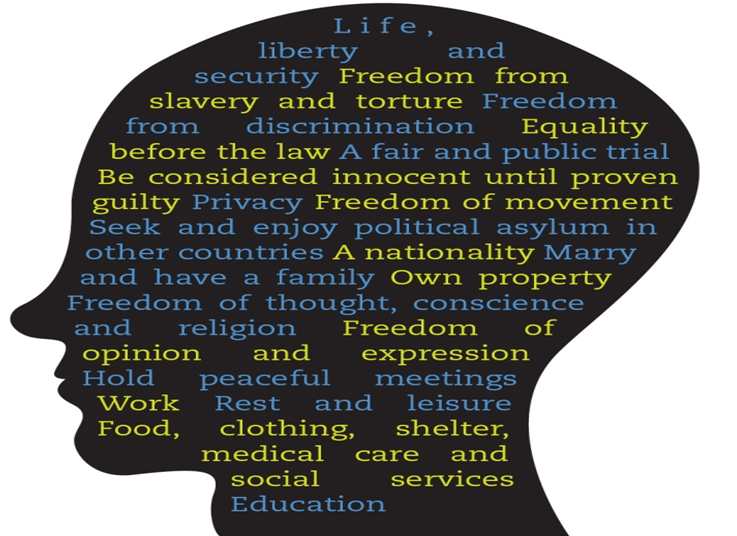
Everyone has the right to life, liberty and security of person
TRANSLATION - This means that everyone has a right to living a fair and just life. It means that everyone has the right to feel safe and to feel free. Free of control and restriction. This is a human right that is important in all cultures, religions and society. Everyone has a right to feel good and to express themselves.

Wednesday, April 27, 2011

United Nations

United Nations
The Declaration Of Human Rights
“Human rights are inscribed in the hearts of people”

What are human rights?
Human rights are the right and freedoms that we all have.
Some of the human rights are based in physical needs.
The right to life. To food. To shelter.
Other human rights protect us.
The right to be free from torture, cruel treatment and abuse
Human rights are also there to ensure we develop to our fullest potential
The right to education. To work. To participate in your community.
Everybody has human rights. It doesn’t matter who you are, where you come from, what language you speak or what religion you belong to. You have a duty to respect the rights of others, just as they have a duty to respect yours.
Nobody can take your rights away

Where do rights come from?
©       Dignity
©       Justice
©       Respect
©       Equality
Human rights were officially recognised as values by the world when the United Nations was set up

What is the United Nations?
The UN is an international organisation that was established in 1945, the year the Second World War ended.
Its founders hoped it would be able to prevent catastrophes like the Holocaust from happening in the future.
So promoting human rights became an aim of the UN, along with maintaining international peace and reducing poverty.

The Universal Declaration Of Human Rights
The United Nations universal Declaration of human rights (UDHR) is the most famous human rights agreement in the world. It contains 30 human rights.


Who Wrote the UDHR?

The people who wrote the UDHR came from: Australia, Chile, China, France, Lebanon, the former Soviet Union, the UK and the US